Catch Basins and Downspout Drainage in Prosper, TX
Underground drainage systems that connect yard inlets and gutters to a single street outlet. Free on-site estimates.
Catch Basins and Downspout Drainage for Prosper TX Homes
Prosper’s new-build homes have a structural drainage gap that many homeowners don’t discover until their first rainy season: downspouts that discharge directly onto the foundation edge or into a yard that can’t absorb the concentrated flow. A 2,500 square foot roof in a moderate rain event generates 600 to 900 gallons of runoff per hour. When four to six downspouts discharge that volume at the foundation corners, the soil saturates immediately.
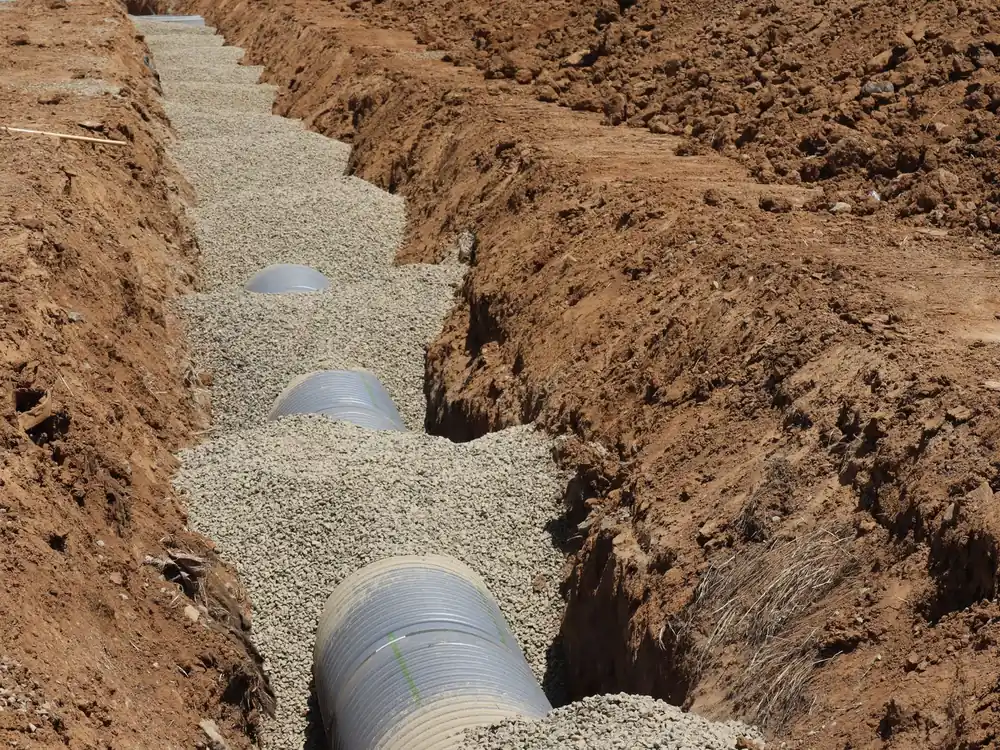
Underground downspout routing connects each gutter outlet to a solid pipe buried below grade and runs it to the street curb or an approved lot line outlet. The discharge happens at the curb, far from the foundation, at a rate the street drainage system is designed to handle.
We install catch basins for yard low points and combine them with downspout connections into shared outlet pipe runs wherever possible, reducing the total amount of pipe and the number of curb penetrations needed.
Why Downspout Discharge Matters at the Foundation
Blackland Prairie Vertisol clay shrinks and swells with moisture changes. The clay immediately adjacent to the foundation is the most critical zone. Concentrated downspout discharge keeps that zone perpetually wet during the rainy season and suddenly dry during summer, creating the worst possible cycle for slab stability. Many Prosper homeowners who develop foundation movement in years two through five of ownership have an unresolved downspout discharge problem as a contributing factor.
What We Install
Grated inlet boxes set flush with lawn grade at low points. Connect to underground outlet pipe at proper fall.
Solid pipe connections from each gutter outlet to a buried collector line. No surface discharge at the foundation.
4 to 6 inch solid pipe collecting multiple inputs and routing to a single curb outlet. Cleanout access on long runs.
Flush street curb outlets at the correct elevation to prevent back-flooding during heavy rain.
How Much Water a Prosper Roof Actually Sheds
The reason splash blocks fail here is arithmetic. One inch of rain on 1,000 square feet of roof produces roughly 620 gallons. A typical Prosper home in Windsong Ranch or Star Trail has 2,500 to 4,000 square feet of roof plan, so a single one-inch event sheds somewhere between 1,550 and 2,500 gallons, and that volume exits through only four to six downspouts. Call it 400 gallons per downspout for an ordinary rain.
Now apply the local rainfall. May in this area averages about 5.45 inches, and North Texas delivers much of it in short high-intensity convective storms rather than steady drizzle. A two-inch afternoon storm sends roughly 800 gallons out of one downspout in under an hour. A splash block relocates that four feet from the slab. On Houston Black clay, which has almost no saturated permeability, four feet is not a solution, it is a delay.
This is why underground downspout routing is usually the highest-value drainage work on a newer Prosper home. It is not glamorous, and it costs far less than a full french drain system, but it removes the largest single concentrated water source on the property from the foundation zone entirely.
Sizing, Depth, and the Details That Decide Whether It Keeps Working
Catch basin failure in Collin County is almost never the basin. It is one of four things underneath it. Insufficient fall is the most common: a collector line needs continuous slope from inlet to outlet, and on the flat back yards typical of Prosper subdivisions there is often only a few inches of available fall across a 60 foot run. That has to be measured, not estimated, because a line that ponds internally will silt up within two seasons on this soil.
Undersized pipe is second. A 3 inch line will take a single downspout and nothing more. When several downspouts and a yard basin feed one run, that line needs to be 4 to 6 inch solid pipe or the system backs up through the highest inlet during exactly the storm it was installed for. Third is outlet elevation: a curb outlet set too low back-floods from street water during heavy events, which is a maddening failure because the system works perfectly for two years and then appears to run backwards.
Fourth is access. Long runs need cleanouts. Fine blackland clay migrates into any pipe system over time, and a run with no cleanout access can only be cleared by excavation. We put cleanouts at directional changes and at midpoints on long runs as standard, because the cost at install time is trivial compared with digging up a finished lawn in year six.
Catch Basin or French Drain: Which One Do You Need
These get used interchangeably and they solve different problems. A catch basin is a surface solution: it takes water that has already pooled on top of the ground at a defined low point and gives it a piped exit. It is the right answer when you can point at the puddle and it is always in the same place.
A french drain is a subsurface solution: it intercepts water moving through the soil profile across a broad area, before it surfaces. It is the right answer when the ground stays spongy between rain events, when there is no single puddle to point at, or when runoff is arriving continuously from an uphill neighbour.
Plenty of Prosper properties need both, and they combine well: the french drain handles the saturated zone, the basins catch the defined low points, and both discharge into one shared collector line to a single curb outlet. Where the yard problem is broad surface pooling rather than either of these, yard and surface drainage covers the regrading options.