Driveway flooding, garage water intrusion, and pool deck runoff in Prosper's master-planned communities. Linear channel drains and surface drainage systems stop sheet flow before it reaches your garage or foundation.
Surface Drainage: The Problem French Drains Can't Solve
A cast iron drain grate set flush in concrete next to a lawn, where surface water from the slab is caught before it reaches the grass.
French drains handle groundwater and slow-moving subsurface moisture. They don't intercept fast-moving sheet flow across concrete, water moving across a driveway during a storm is traveling too quickly to enter a subsurface system. That water needs to be caught at the surface, where it's flowing.
In Prosper, this distinction matters because the Blackland Prairie clay under every driveway, patio, and pool deck is nearly impermeable. A North Texas thunderstorm drops 2 to 3 inches of rain per hour, and virtually all of it becomes surface runoff immediately. On a hard surface, that runoff moves fast and it all goes to the lowest point. If the lowest point of your driveway is the garage door threshold, which is extremely common in Prosper's new construction, that water goes inside.
A channel drain catches this flow at the surface level. It's a U-shaped drain body set into the concrete with a grate at the surface, the slot across the driveway that looks like a speed bump but is actually a drain. Water flowing down the driveway hits the slot, drops in, and routes through a buried pipe to the street outlet. The garage stays dry.
Prosper's Windsong Ranch, Star Trail, Gentle Creek, and other master-planned communities also have large pool decks, covered patios, and porte-cochères that generate significant surface runoff during storms. Channel drains handle all of these applications using the same linear drain principle sized for the surface area they're serving.
Channel Drain Applications in Prosper
Driveway Apron Drains
Installed across the driveway in front of the garage door to intercept sheet flow before it reaches the garage. The most common channel drain call in Prosper's new construction communities. Critical when the driveway pitches toward the house or the garage floor sits below the driveway apron.
Pool Deck Perimeter Drains
Pool decks in Prosper's larger-lot communities (Windsong Ranch, Gentle Creek, Star Trail) shed significant water from rainfall and splash-out. Channel drains along the pool deck perimeter or at low points prevent water from running across walkways, toward the house, or pooling against landscaping.
Patio Edge Drains
Covered patios and uncovered concrete patios adjacent to the house can direct rain runoff toward the foundation when the patio slopes even slightly toward the structure. A channel drain along the house-side edge of the patio intercepts that flow before it reaches the foundation zone.
Porte-Cochère and Courtyard Drains
Prosper's higher-end communities include covered entryways and enclosed courtyards that trap water with no natural outlet. A channel drain across the low point with a buried outlet pipe is the standard solution for these architectural features.
Garage Floor Drains
Interior garage floor drains handle water tracked in by vehicles, washdowns, and overflow that makes it past the garage door during extreme events. A floor drain inside the garage connects to a drain line that exits to the yard or street.
When You Need Channel Drains vs. French Drains vs. Both
How a French drain is built in Blackland Prairie clay: perforated pipe, holes down, in washed #57 stone wrapped in non-woven fabric, 18 to 36 inches deep, falling at least 1 inch every 8 feet to a daylight outlet. Not to scale.
Channel Drain
Water sheets across hard surfaces (concrete driveways, patios, pool decks) and the problem is where it goes (toward the garage, house, or pooling on the hard surface itself.
French Drain
Water pools in soil) yard, lawn, or unpaved areas. The problem is subsurface saturation and groundwater that has nowhere to drain through the clay.
Both
The driveway floods the garage (channel drain) AND the yard holds standing water on soil (French drain). Common in Prosper lots where the hard surface drainage and soil drainage are both insufficient.
Channel Drain Questions
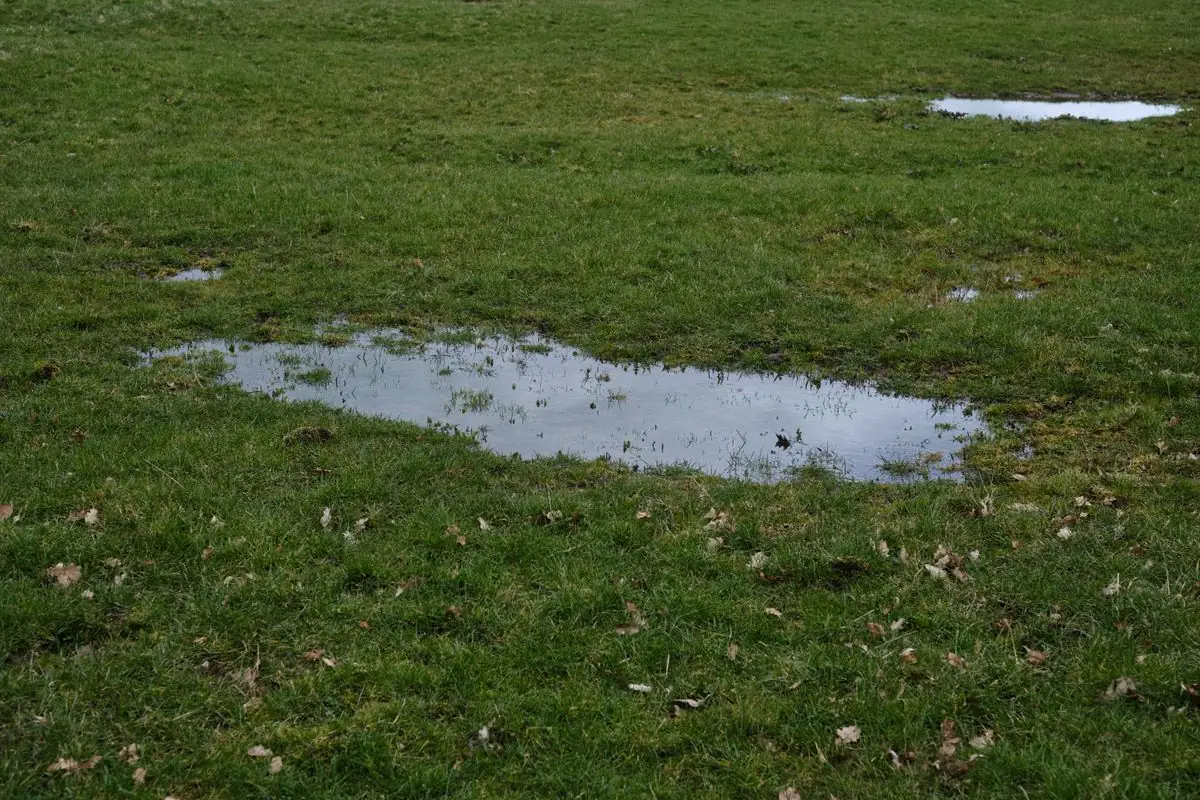
Water standing on a lawn a day after rain: the surface is sealed and the water has nowhere to go.
What is a channel drain and how is it different from a French drain?
A French drain handles water below the soil surface, a perforated pipe in gravel intercepts groundwater and slow-moving soil moisture. A channel drain handles water on hard surfaces, a linear slot or grate at the concrete surface intercepts sheet flow from rain running across a driveway, patio, or pool deck. French drains and channel drains solve different problems. If your yard holds water on soil, you likely need a French drain. If water sheets across your driveway toward the garage or across your patio toward the house, that's a channel drain problem. Many Prosper properties have both issues and benefit from both systems.
Why does my Prosper driveway flood the garage during storms?
Driveways in Prosper's master-planned communities often pitch slightly toward the garage, either from the original grade or from settling over time. During a North Texas thunderstorm, a 1,500 square foot driveway can generate 20 to 25 gallons of runoff per minute during a 3-inch-per-hour rain event. That's all moving toward the lowest point, which in a garage-front driveway is usually the garage door threshold. A channel drain installed across the driveway at the low point, typically 4 to 8 feet in front of the garage door, intercepts that sheet flow and routes it to the street before it reaches the door.
Do Prosper HOAs allow channel drains in driveways?
Most Prosper HOAs permit channel drains when they're installed flush with the driveway surface and finished with a grate that matches the driveway aesthetic. The critical HOA concern is the same as with French drains: where does the water go after it enters the drain? A channel drain that routes water to the street in a buried pipe is almost universally approved. A channel drain that discharges to a neighboring lot or a common area requires additional HOA review. Ask for the project description and outlet routing documentation that most Prosper HOAs require for approval.
Can a channel drain be installed in an existing driveway?
Yes. A slot is cut in the existing concrete with a concrete saw, the channel body excavated, and new concrete poured around the drain frame. The grate sits flush with the driveway surface when complete. The saw cut needs to be positioned exactly where the sheet flow crosses, so it should be verified with a level before cutting because a channel drain installed 2 feet upstream of the actual low point doesn't collect the flow that makes it to the low point. Concrete cutting does add cost compared to installation during a new concrete pour, but it's a standard process.
How much does channel drain installation cost in Prosper TX?
A standard driveway apron channel drain runs $900 to $1,800 for most Prosper applications. That includes the concrete saw cut, the channel drain body, the grate, the buried outlet pipe to the street, and concrete restoration. Longer runs, pool deck perimeter systems with multiple connection points, or installs that require a larger collector pipe running significant distances to the outlet are higher. Quotes are by the job, after the site has been seen.
What type of grate should I use for a Prosper driveway?
For a residential driveway that sees passenger vehicle traffic, a galvanized steel grate rated for the vehicle load is standard. These are functional, priced well, and available in a width that suits most driveway apron installs. For pool decks and patio areas where aesthetics are more important, a stainless steel or polymer slotted grate with a narrower slot profile is less visible and blends into the concrete. For RV pads or heavy vehicle access, ductile iron grates carry a higher load rating. Some Prosper HOAs specify grate styles for architectural consistency, so check before ordering.