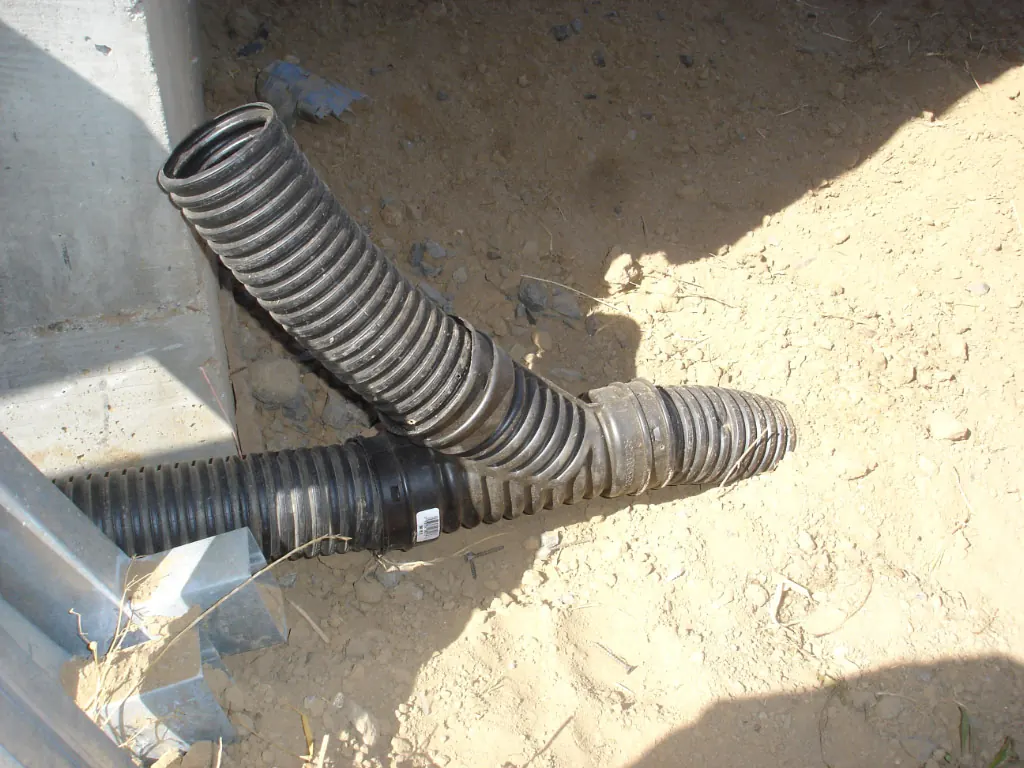
French Drain Installation in Prosper, TX
Prosper Drainage handles French drain installation in Prosper, TX: side-yard runs between houses, foundation perimeter drains and back-yard intercepts, built for the Houston Black clay and routed to an outlet your lot was designed for. French drains in Prosper run $23 to $36 per foot at Dallas-area rates.
Signs You Need a French Drain in Prosper TX
Prosper’s Blackland Prairie clay is slow to signal drainage failure. By the time standing water is obvious, the problem has usually been building for multiple rain cycles. These patterns point to a French drain as the fix.
Blackland clay should drain within 24 to 48 hours even in its saturated state if the yard has adequate fall. Water that sits for two or more days means the soil has no natural outlet and the problem won't self-correct.
A persistent wet zone between rain events (soggy turf, sinking underfoot, roots rotting) indicates a water concentration point. Water from uphill grade, a neighbor's yard, or a roof line is channeling to that spot. A French drain intercepts it at the source.
In Collin County clay, water sitting at a foundation edge saturates the soil on one side of the slab while the other side dries. The clay expands on the wet side and contracts on the dry side, and that differential movement is what causes slab cracking. Cracks appearing in drywall or sticking interior doors are often downstream symptoms of a drainage problem outside.
The Houston Black profile can move 3 to 6 inches through its upper 10 feet between its wettest and driest states. If turf lifts, sidewalk joints rise, or the lawn surface becomes uneven in summer heat, the clay shrink-swell cycle is working the soil. Keeping the moisture level more consistent with a drainage system reduces the amplitude of the cycle.
Prosper’s newer subdivisions place homes on lots with tight grade differentials. An upslope neighbor’s yard can direct significant runoff onto a downslope property during heavy rain. A French drain along the upslope property line captures that flow before it becomes your problem.
A single downspout during a heavy Collin County storm can discharge 12 to 20 gallons per minute at one point on the soil. If that discharge point is 2 to 4 feet from the foundation, the standard placement on most Prosper new builds, the soil at that corner stays saturated through much of the wet season. Routing downspouts underground to the street solves this entirely.
What a French Drain Is and When a Prosper Home Needs One

A French drain is a perforated pipe set in a trench of clean washed gravel, wrapped fully in filter fabric, that collects water below grade and carries it by gravity to a lower outlet. A Prosper home needs one when water is sitting in the soil profile rather than just on the surface: a yard that stays spongy between storms, a low corner that ponds for two days after every rain, runoff crossing in from an uphill neighbor, or wet soil standing against the foundation. Dallas-area installs run $23 to $36 per linear foot, so a 60 foot side-yard run sits around $1,370 to $2,130 before extras like sod, irrigation repair or a catch basin. Full ranges are on our French drain cost guide for Prosper TX.
Prosper sits in the heart of Collin County’s Blackland Prairie. The USDA describes the Houston Black clay under most of the town as very slow to take in water: rain enters fast while the soil is dry and cracked, then very slowly once it is moist. In a wet spring that means a few storms in a row seal the ground, and every storm after that runs across the surface, collects along property lines and sits against foundations.
In Prosper’s new-build subdivisions, the problem is compounded by construction grading. Builder lot grading is designed to pass code requirements for drainage direction, but those grades often create low spots near the home or along interior lot lines that weren’t apparent until the first heavy rain. Homeowners in Windsong Ranch, Gentle Creek, Star Trail, and the Preston Road corridor commonly discover drainage issues in their first or second season. The homes didn’t ship from the builder with a drainage problem on the inspection report because the inspection happened during a dry period.
The fix that lasts is a French drain built for this soil: a perforated pipe in washed angular stone, fully wrapped in fabric so the clay cannot silt it, falling to an outlet the lot was graded toward. That last part decides more Prosper jobs than any other, so it gets its own section below.
Where a Prosper French Drain Empties

The Town of Prosper’s Engineering Design Standards (Section 6.14) prohibit residential lot-to-lot surface drainage and grade new lots one of three ways: Type A sends all water to the street, Type B splits it between the street and the rear lot line, and Type C sends it all to the rear, which is only allowed where the lot backs onto an alley, open space or a drainage easement. A French drain should follow the pattern your lot was built with. On a Type A lot that usually means a run down the side yard to the curb; on a Type C lot it means the rear swale or easement.
Texas Water Code Section 11.086 adds the legal edge: nobody may divert surface water in a way that damages a neighbor’s property by overflow. Pointing a drain at the lot next door is the one outlet that can turn a drainage fix into a lawsuit. When the curb is higher than the back yard, the options are a pump-assisted outlet or a rear easement, never the neighbor’s fence line. Our guide to French drain outlet options in Prosper walks through each lot type, curb outlets, pop-up emitters and why dry wells fail in this clay.
French Drain Applications in Prosper TX

Foundation Perimeter Drainage
Collin County’s Blackland Vertisol clay expands when it absorbs water and contracts when it dries. This shrink-swell cycle puts lateral pressure on foundation walls and creates differential settlement beneath slabs. A French drain installed around the foundation perimeter at footing depth intercepts water before it saturates the soil closest to the slab. For new homes in Prosper’s master-planned communities where the exterior grade sometimes slopes toward the house, a perimeter French drain is often the single most protective drainage investment, and it costs far less than slab repair after the soil has already moved.
Property-Line Drainage in Tight Subdivision Lots
Prosper’s newer subdivision phases feature lot sizes ranging from roughly 6,000 to 12,000 square feet in communities like Star Trail, Whitley Place, and Windsong Ranch’s recent phases. On these tighter lots, a grade differential of 6 to 12 inches between adjacent homes can direct significant runoff from one property onto another. A French drain along the upslope property line intercepts that flow and routes it to the street outlet before it saturates the downslope yard or reaches a foundation. These systems are designed to comply with HOA requirements for outlet location and surface restoration.
Yard and Surface Drainage Combined Systems
Some Prosper yards have both subsurface saturation and surface pooling problems. A French drain handles the subsurface component, but surface water that accumulates faster than it can enter the gravel trench needs a surface inlet. A French drain is often combined with a catch basin or channel drain that captures surface water at the low point and routes it into the same underground pipe system. This addresses yards that flood both from groundwater rising and from rainfall that can’t drain fast enough through the clay surface.
Downspout Routing to Underground Pipe
Gutters that discharge at the foundation edge are one of the most common proximate causes of drainage problems in Prosper’s new homes. During heavy rain, a single downspout can discharge 12 to 20 gallons per minute at one location. Connecting those downspouts to underground solid pipe that routes to the street eliminates concentrated discharge at the worst possible location. The underground pipe has to be sized to handle the combined load from the French drain and downspout connections, preventing system surcharge during peak storm events.
HOA Approval for French Drain Work in Prosper

Almost every new-build neighborhood in Prosper is governed by an HOA, and virtually all of them require approval before drainage work begins. This is one of the most common sources of delay homeowners don’t anticipate, not because HOAs routinely block drainage work, but because the approval process takes 2 to 4 weeks and many homeowners don’t know to start it before calling a contractor.
The documentation HOAs typically require for drainage installation includes a written project description (what is being installed, where, and why), a simple site diagram showing the trench location relative to property lines, and a statement of where the outlet terminates. Some HOAs also ask for photos of the existing drainage problem as supporting documentation for approval. Ask for the project description and site sketch in a format that meets standard Prosper HOA submission requirements.
The most common HOA concern with drainage work is outlet routing. HOAs for Prosper master-planned communities typically permit outlets to the street curb but may restrict outlets directed toward common areas, parks, or neighboring lots. Outlet routing that terminates at the street or a drainage easement is what HOAs routinely approve. The filter fabric and surface restoration requirements HOAs sometimes specify belong in any good installation: commercial-grade geotextile and a surface restored to match the surrounding yard.
Start the HOA approval process before scheduling a work date. Ask for the supporting documentation soon after the site estimate so you can submit to your HOA right away.
Why French Drains Fail in Prosper’s Blackland Clay
A French drain installed correctly in Collin County clay lasts 20 to 25 years with minimal maintenance. A French drain installed with shortcuts common in sandy or loamy soils fails in 3 to 5 years here. The difference comes down to filter fabric quality, gravel specification, and installation slope.
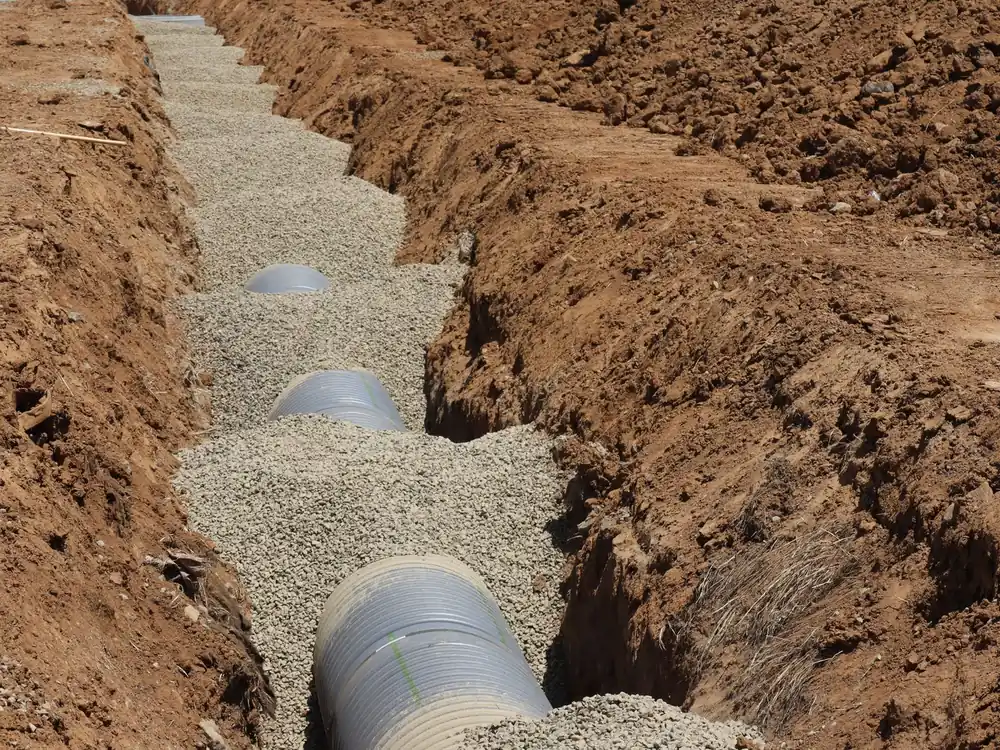
Filter fabricis the critical component. Blackland clay particles are fine enough to migrate through gravel void spaces without a geotextile barrier, slowly filling the air pockets that allow the system to drain. A gravel bed with 30 to 35 percent void space can be reduced to near zero in a few years if the fabric is absent, under-spec’d, or improperly installed. The right fabric is a non-woven polypropylene geotextile rated for clay soils, wrapped around the full assembly, sides and bottom, not just draped over the top. Lateral pressure from clay expansion drives migration from all directions.
Gravel specification matters in clay. Rounded pea gravel packs more tightly than angular crushed stone. In soils where lateral pressure is significant, those packed voids fill with clay particles faster. Clean angular stone is the right choice here.
Installation slope is the third factor. A French drain needs minimum 1 inch of fall per 8 feet of run to maintain gravity flow. A flat section accumulates sediment and eventually creates standing water in the pipe. Slope should be verified with a level and outlet discharge confirmed on completion.
French Drain Cost in Prosper TX
Published Dallas-area pricing is $23 to $36 per linear foot installed. The table multiplies that out by run length, which is how most Prosper jobs are scoped: a side yard is usually 40 to 60 feet, a back fence line 60 to 100.
| Run | Typical Range | Where it fits |
|---|---|---|
| 40 ft | $910 to $1,420 | One side yard or one wet corner |
| 60 ft | $1,370 to $2,130 | Full side yard to the curb on a Type A lot |
| 80 ft | $1,820 to $2,850 | Back fence line plus a short outlet run |
| 100 ft | $2,280 to $3,560 | Rear intercept routed around the house |
| Outlet, sod, irrigation, catch basins | Quoted per site | Depends on curb distance and what the trench crosses |
Source: HomeBlue Dallas French drain cost data ($23 to $36 per linear foot). Nationally, LawnStarter reports a $5,000 average with most homeowners paying $1,650 to $12,250.
Every quote is free and done on site. Outlet distance, utility locations, HOA outlet rules and side-yard access all move the price in ways a photo can’t show.
A Type A lot with a wet side yard
An example of a common Prosper job, not a record of a specific one. A two-story home on a Type A lot, where the plan sends all water to the street. The side swale between this house and the next was flattened when the fence went in, and after each spring storm the side yard holds water against the slab for two days.
The fix: a 60 foot French drain down the side yard at 18 to 24 inches, perforated pipe in washed angular stone with a full fabric wrap, falling at least 1 inch every 8 feet to a solid line that exits at the curb. The nearest downspout ties into the solid section so roof water stops landing in the same spot. Before digging: an 811 locate 48 hours ahead and the HOA submission with the outlet marked on the sketch.
Cost at Dallas-area rates: about $1,370 to $2,130 for the 60 foot run, with the curb outlet, downspout tie-in and sod repair quoted on site. What goes wrong when it’s done cheaply: pea gravel or a top-only fabric layer lets the clay in, and the drain slows within a few seasons.
The French Drain Installation Process in Prosper
A Prosper French drain install takes six steps and one to three days on site. The two that decide whether the system still works in year ten are step 4, the full geotextile wrap, and step 5, an outlet that is genuinely lower than everything feeding it.

Walk the property, identify where water enters and concentrates, check grade with a level, and confirm legal outlet options. Free, no obligation.
Required by Texas law. 811 must be called 48 hours before excavation so utilities are located before any digging starts.
Dug to the required depth and slope. Typically 18 to 36 inches depending on whether the drain handles surface runoff, groundwater, or foundation perimeter drainage.
Perforated HDPE pipe set in clean angular gravel, fully wrapped in non-woven geotextile filter fabric rated for Blackland clay soils.
Solid outlet pipe to the street curb, a drainage easement, or an approved HOA outlet point. Verified to maintain continuous downhill slope.
Backfill, compaction, sod replacement, and cleanup. Final flow test to confirm water discharges at the outlet before the job is closed out.
- Foundation perimeter French drains
- Yard and low-spot drainage
- Property-line intercept drains
- Downspout underground routing
- Combined French drain and catch basin systems
- HOA-compliant outlet routing
- Free on-site estimates
- Clay permeability (USDA)Very slow
- Annual rainfall38 to 42 inches
- Peak seasonMarch to May
- Shrink-swell movement3 to 6 in, upper 10 ft
- System lifespan (proper install)20-25 years
Get a Free French Drain Quote in Prosper TX
Your site is walked, the water source identified, and you get a written estimate. No charge, no obligation.
French Drains in Prosper TX: Questions and Answers

Common questions from Prosper homeowners. Ask anything else at the on-site estimate.
How much does French drain installation cost in Prosper TX?
How deep does a French drain need to be in Prosper TX?
Will a French drain fix my property-line drainage problem?
Can a French drain protect my foundation in Collin County clay?
Do I need HOA approval for French drain installation in Prosper TX?
Why does standing water take so long to drain in Prosper TX?
What are the downsides of a French drain?